
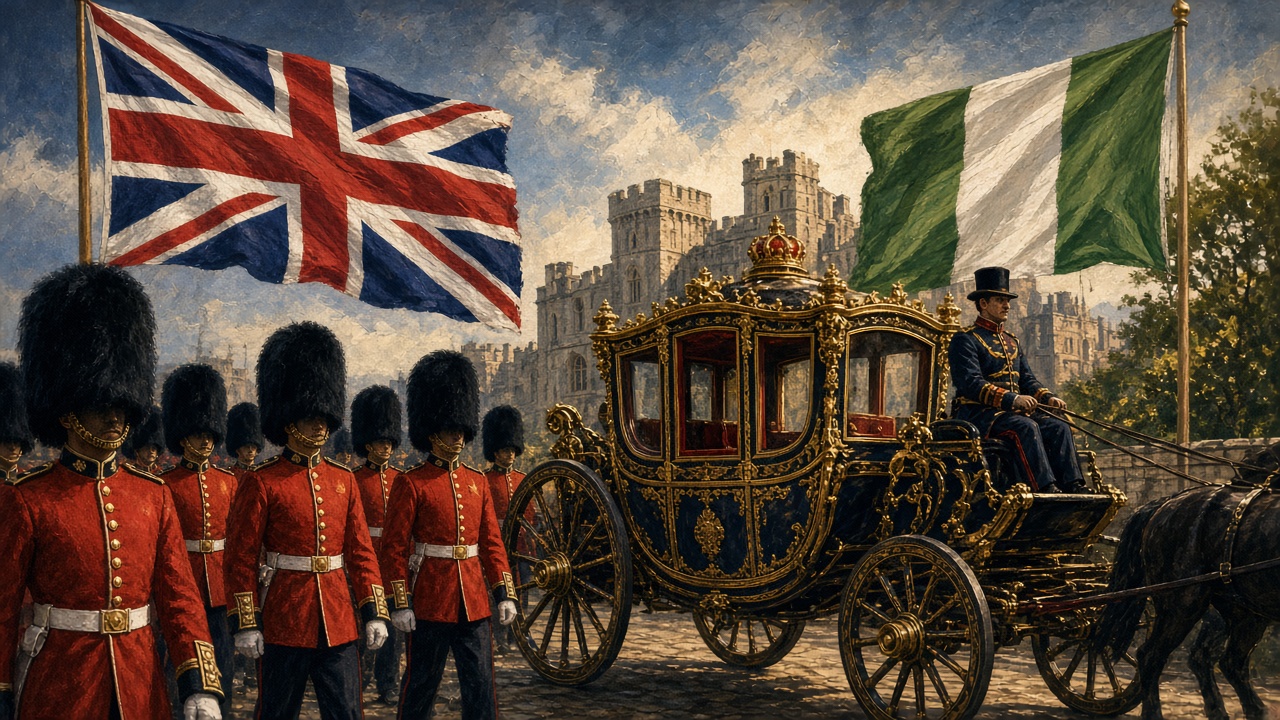
The King has hosted President Bola Ahmed Tinubu of Nigeria and his wife, Oluremi Tinubu, at the first Nigerian state visit to the United Kingdom for 37 years, an occasion that placed the Commonwealth at the heart of a remarkable week at Westminster and underlined the monarchy's enduring diplomatic reach.
The ceremonial followed the trusted choreography of the modern state visit. The presidential party was received with full military honours, a guard of honour presenting arms beneath a pale spring sky, and the King and his guest inspected the troops together, a ritual the monarch has performed scores of times and which still seems to concentrate his attention. The day closed with a state banquet at which both heads of state spoke warmly of the friendship between their countries. The last such visit took place in 1989, and the length of that interval gave every trumpet blast a particular resonance.
The timing could hardly have been more arresting. In the same week, President Volodymyr Zelensky of Ukraine addressed parliamentarians at Westminster, and the language of war and peace echoed around the estate. Against that backdrop, the Nigerian visit was a reminder of the monarchy's quieter function: the patient cultivation of friendships that outlast the electoral cycle and often outlast the politicians who come and go beneath the palace windows.
Trade, energy and the diaspora
Nigeria is Africa's most populous nation, home to more than 200 million people, and one of the continent's largest economies. The substance of the visit ranged across trade, energy, education and the ties of the diaspora, the hundreds of thousands of people of Nigerian heritage who have made their lives in Britain and who form one of the country's most dynamic communities. Their contribution, in business, medicine, academia and the arts, was the unspoken backdrop to every conversation.
Officials on both sides were careful not to confuse ceremony with contract. No single announcement was ever likely to define the visit; its value lay in the framework it created, in ministerial meetings, business delegations and a shared commitment to keep talking. Energy featured prominently, as it must when Africa's largest oil producer sits down with a Britain hungry for reliable partners, and education ran it close: Nigerian students now form one of the largest groups of international students at British universities, a living bridge between the two countries.
The Visit at a Glance
- President Bola Ahmed Tinubu and his wife Oluremi were hosted by the King on 18 March 2026.
- It was the first Nigerian state visit to the United Kingdom for 37 years, the last having taken place in 1989.
- The programme included a guard of honour and a state banquet.
- Trade, energy, education and the diaspora dominated the agenda.
- The visit fell in the same week that President Zelensky addressed parliamentarians at Westminster.
- Nigeria, Africa's most populous nation, is a fellow member of the Commonwealth.
A Commonwealth relationship
For the King, the visit touched one of the longest standing commitments of his public life. As Prince of Wales he travelled to Nigeria on several occasions and spoke often of the Commonwealth as a family of nations whose worth is measured in practical cooperation rather than sentiment. He has returned to the subject year after year, long before the crown was his. He is now Head of the Commonwealth, the role his mother made her own, and those who watch him closely say it sits comfortably on his shoulders.
The feeling is mutual in Abuja, where the Commonwealth is seen not as a relic but as a platform, and where the King's long personal interest in Nigeria's cultures, faiths and young people is well remembered. Diplomats talk of atmospherics as though they were decoration; in truth they are the substance. A state visit cannot sign a trade deal, but it can make one considerably easier to imagine.
The test of this week will come in the months ahead, in trade missions and scholarship schemes and the slow, unglamorous work of ministers. For one spring day, though, the oldest and the newest things about Britain, its monarchy and its modern Commonwealth, were doing the work for which they were designed, and doing it rather well.