
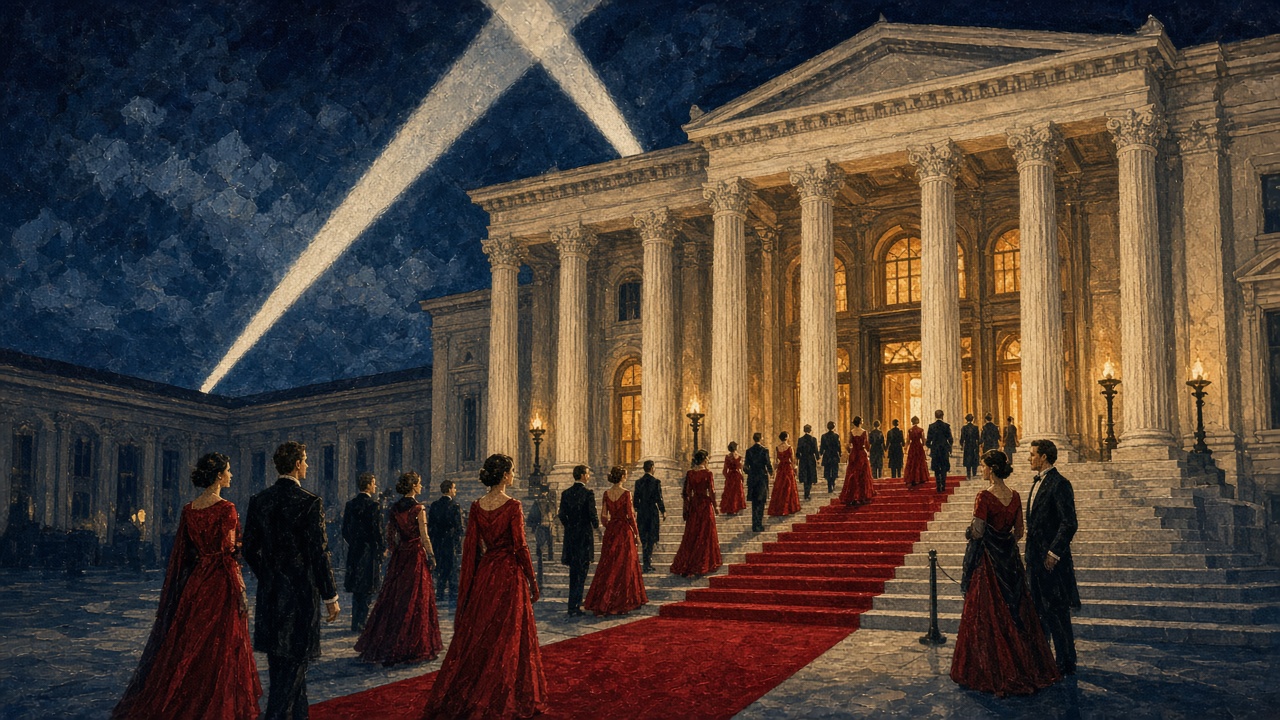
The great and the good of British culture climbed the steps of the British Museum on Saturday night for the institution's second annual ball, a red-themed fundraiser that drew Hollywood names, rock royalty and, this being Bloomsbury in 2026, a wall of protest outside.
Maya Jama, Benedict Cumberbatch and Sir Mick Jagger, accompanied by Melanie Hamrick, led a guest list that also included Gwendoline Christie, Cush Jumbo, Lesley Manville and Bianca Jagger. George Osborne, the museum's chairman and the evening's driving force, worked the carpet in a velvet dinner jacket, while the former Vogue editor Edward Enninful lent the occasion his unimpeachable fashion blessing.
A theme woven through history
The dress code was red, and the reason hung in the galleries beyond the champagne: the museum's landmark Bayeux Tapestry exhibition, the first time the eleventh-century embroidery has been shown in Britain. Several guests took the brief literally. The designer Rosanna Konarzewski arrived in a gown styled after the tapestry itself, its borders picked out in woollen stitch, a look that divided opinion on the carpet and delighted the photographers.
The Ball at a Glance
- The second British Museum Ball took place on Saturday 17 October, with a red dress code.
- Guests included Maya Jama, Benedict Cumberbatch, Sir Mick Jagger, Gwendoline Christie and Lesley Manville.
- The evening was tied to the museum's Bayeux Tapestry exhibition, the tapestry's first showing in Britain.
- Protesters projected "Drop BP" and "Blood Ball" onto the facade outside.
- Last year's inaugural ball raised more than 2.5 million pounds for the museum's masterplan.
Protest in light
Outside, the evening's other spectacle played out on the museum's own columns. Campaigners beamed the slogans "Drop BP" and "Blood Ball" onto the facade in protest at the museum's continuing sponsorship relationship with the oil company, while the activist Georgie Robertson walked the pavement in a gown bearing the words "Return the Marbles", a reminder that the Parthenon sculptures remain the collection's most contested treasures. Guests arriving up the crimson carpet passed within feet of the projections; most kept their eyes on the door.
Money for the masterplan
For all the noise, the ball's purpose is serious. The inaugural event last year raised more than 2.5 million pounds, and Saturday's edition, with tables reportedly changing hands at eye-watering prices, is expected to exceed it. The proceeds feed the museum's vast redevelopment masterplan, including the long-promised programme to phase out fossil fuel use across the Bloomsbury estate, a detail the museum's supporters deploy, with some justification, against the protesters' charge sheet.
By midnight, the searchlights had dimmed and the last of the red gowns had swept off into waiting cars. The museum had its money, the protesters had their footage, and London had its newest fixture in the social calendar: controversial, glittering and, on this evidence, here to stay.