
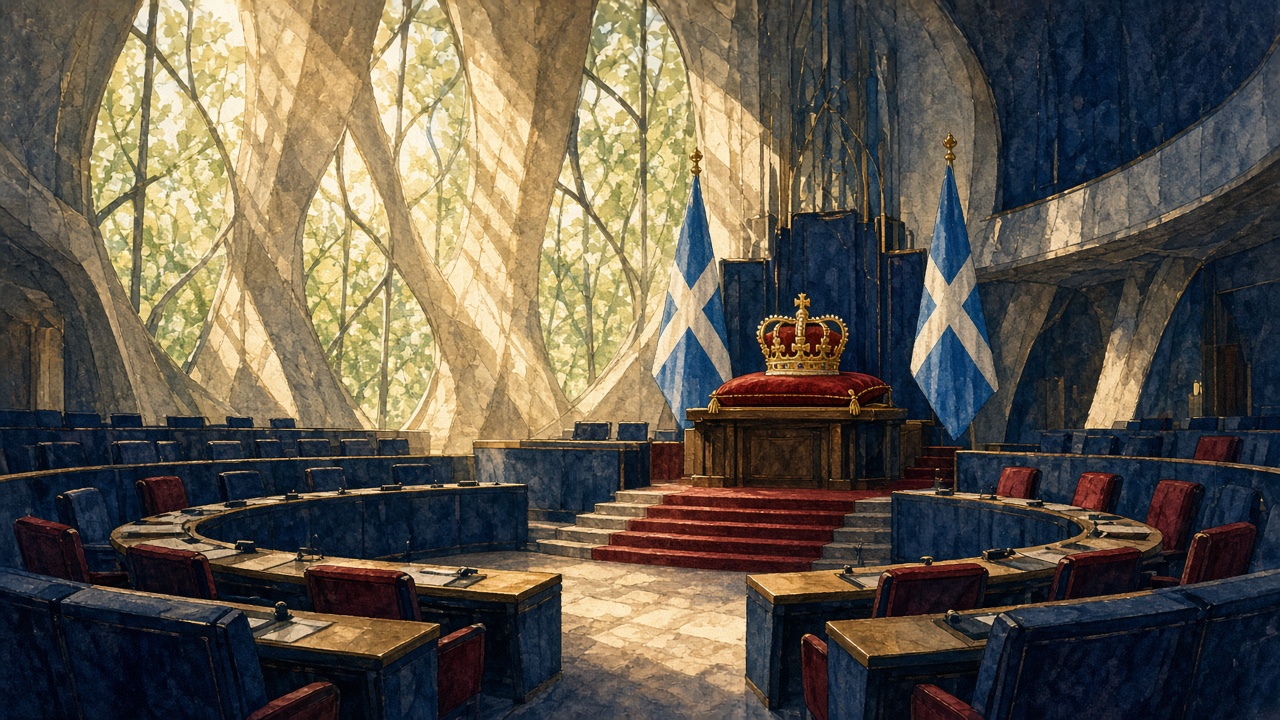
The King opened the seventh session of the Scottish Parliament on Saturday, performing one of the Crown's most distinctive constitutional duties at a moment of unusual delicacy in the politics of the Union.
In his address to MSPs at Holyrood, His Majesty urged members to help build a "fair and prosperous society", words that carried the measured neutrality expected of the sovereign while acknowledging the weight of the task before the new session.
The ceremony followed the SNP's fifth successive election victory in May and the re-appointment of John Swinney as first minister. It came, too, just five days after Sir Keir Starmer announced his resignation as prime minister, a coincidence of timing that lent an occasion of state an added layer of national significance, with Westminster's attention fixed on its own drama while Holyrood marked its renewal.
The address, delivered in the chamber before MSPs, dignitaries and invited guests, touched on the responsibilities of public service and the place of the Scottish Parliament in the life of the nation, themes to which the King has returned throughout his reign.
Ceremony at Holyrood
The opening of a session of the Scottish Parliament is among the most visually striking occasions in the constitutional calendar. The Crown of Scotland, the oldest crown jewels in Britain, is borne into the chamber in procession, and the mace, the symbol of the Parliament's authority, takes its place before the members, as it has at every opening since 1999.
The riding procession, the ceremonial journey through Edinburgh that accompanies the occasion, drew crowds in the summer sunshine. Inside the chamber, the King addressed a Parliament whose composition was settled by May's election but whose political weather remains anything but settled, with the new session's first tests already visible on the horizon.
Saturday's ceremony crowned a series of traditions that open a Holyrood term. In May, the Duke of Edinburgh joined MSPs for the Kirking of the Parliament, the service at St Giles' Cathedral that has blessed each new session since the Parliament's re-establishment.
The Seventh Session Opens
- The King opened the seventh session of the Scottish Parliament on 27 June 2026.
- He urged MSPs to help build a "fair and prosperous society".
- The ceremony followed the SNP's fifth election victory in May and John Swinney's re-appointment as first minister.
- It came five days after Sir Keir Starmer announced his resignation as prime minister.
- The Duke of Edinburgh joined MSPs for the Kirking of the Parliament at St Giles' Cathedral on 13 May.
A delicate moment for the Union
The King's role on such occasions is strictly constitutional. He opens the session as sovereign, delivers an address settled within the conventions of his position and takes no part in the arguments that follow. His words are chosen to offend no one and to encourage everyone, a discipline he has observed throughout his public life. Yet the context in which he performs that duty is rarely neutral in its implications, and Saturday was no exception.
An SNP administration beginning its fifth term, a first minister newly re-appointed, and a Westminster in the throes of choosing a new prime minister: the pieces on the Union's chessboard are in motion, and the question of Scotland's constitutional future, never far from Holyrood's debates, will attend this session as it has attended every one since 1999, and as the May result has done nothing to quieten.
For the King personally, Holyrood is familiar ground. He has opened sessions of the Scottish Parliament before, both as heir and as sovereign, and his affection for Scotland is long established and frequently expressed. That ease was evident on Saturday, in a ceremony conducted with the quiet precision that occasions of state demand.
The seventh session now begins its work. Legislation will be introduced, ministers questioned and the arguments of May's campaign resumed across the chamber floor. The Crown has played its part; the politics, as ever, belongs to the politicians, and there will be no shortage of it in the months ahead.