
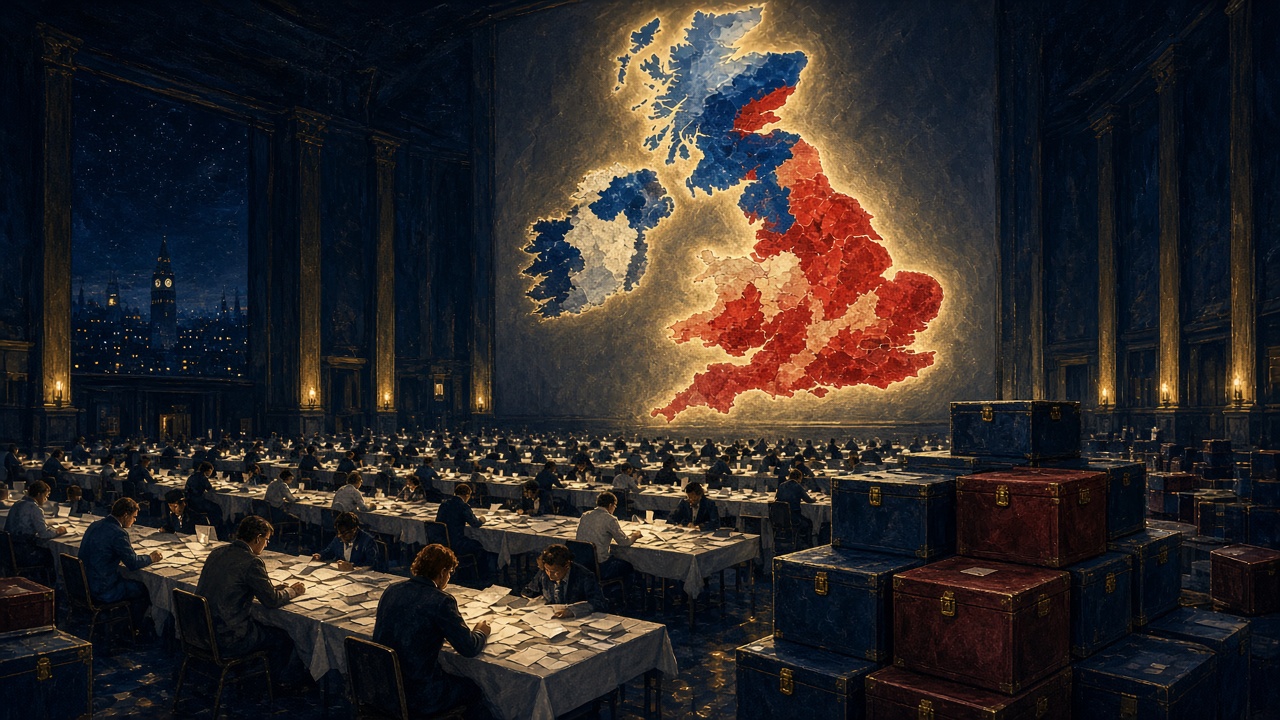
The results are in, and the map of British politics has been redrawn in a single night. Reform UK has surged across England, Labour has suffered an historic collapse in Wales, and the SNP has won the most seats in Scotland for the fifth time, in a set of elections that will be studied for a generation.
Counting concluded this evening in contests that spanned three nations and two systems of government. In England's local elections, Reform UK made sweeping gains at the expense of both Labour and the Conservatives, converting its long held poll lead into bricks and mortar control of council chambers.
But it was in Wales that history was made. Labour, the party that has dominated Welsh public life for a century, won just 9 of the Senedd's 96 seats. Plaid Cymru took 43, the most of any party, and Reform UK took 34, a result that would have been unthinkable at the last election.
Eluned Morgan resigned as First Minister of Wales as the scale of the defeat became clear. Rhun ap Iorwerth was declared elected and is now expected to become First Minister, the first person to hold that office from a party other than Welsh Labour.
Wales turns its back on Labour
The symbolism is difficult to overstate. Wales has been Labour's most reliable stronghold through every era of the party's fortunes, and its loss breaks an assumption on which Labour strategy has rested for generations. A Plaid Cymru led government in Cardiff will test the party in office for the first time, and will change the tone of every negotiation between Cardiff Bay and Westminster.
In Scotland, John Swinney declared victory after the SNP won the most seats at a Scottish Parliament election for the fifth time. The result extends the party's extraordinary hold on Holyrood and will reignite the constitutional debate that never fully sleeps in Scottish politics.
There was a quieter landmark in London. The Liberal Democrats won every seat on Richmond upon Thames council, a clean sweep that leaves the authority without an official opposition and raises genuine questions about how scrutiny will function there. Council officers will now have to consider how committee places and scrutiny roles are allocated when every seat on the authority is held by a single party.
The Night in Numbers
- Labour won only 9 of 96 Senedd seats; Plaid Cymru took 43 and Reform UK 34.
- Rhun ap Iorwerth is expected to become the first First Minister of Wales not from Welsh Labour.
- The SNP won the most seats in Scotland for the fifth time; John Swinney declared victory.
- The Liberal Democrats won every seat on Richmond upon Thames council, leaving it with no official opposition.
- The Home Office said more than 200,000 migrants have crossed the Channel in small boats since records began in 2018.
What it means for Sir Keir
For the Prime Minister, the question is no longer whether these results are bad but how bad, and what answer Downing Street can offer. Sir Keir is expected to announce tomorrow that Gordon Brown and Harriet Harman will join his operation as advisers, a signal that he intends to fight his way back with the help of the party's elder statesmen.
The context that framed the night arrived from the Home Office, which recorded that more than 200,000 migrants have now crossed the Channel in small boats since records began in 2018. The figure, published as the results came in, is a reminder of the issue that has powered Reform's rise and defeated successive governments.
Britain did not move in one direction on Thursday; it moved in four, and Labour was left standing still. England shifted towards Reform, Wales towards Plaid Cymru, Scotland stayed with the SNP, and a corner of London turned entirely yellow. The next general election is years away, but the shape of the argument that will decide it is suddenly visible. What no one in any party can seriously claim this morning is that the old certainties still hold.