
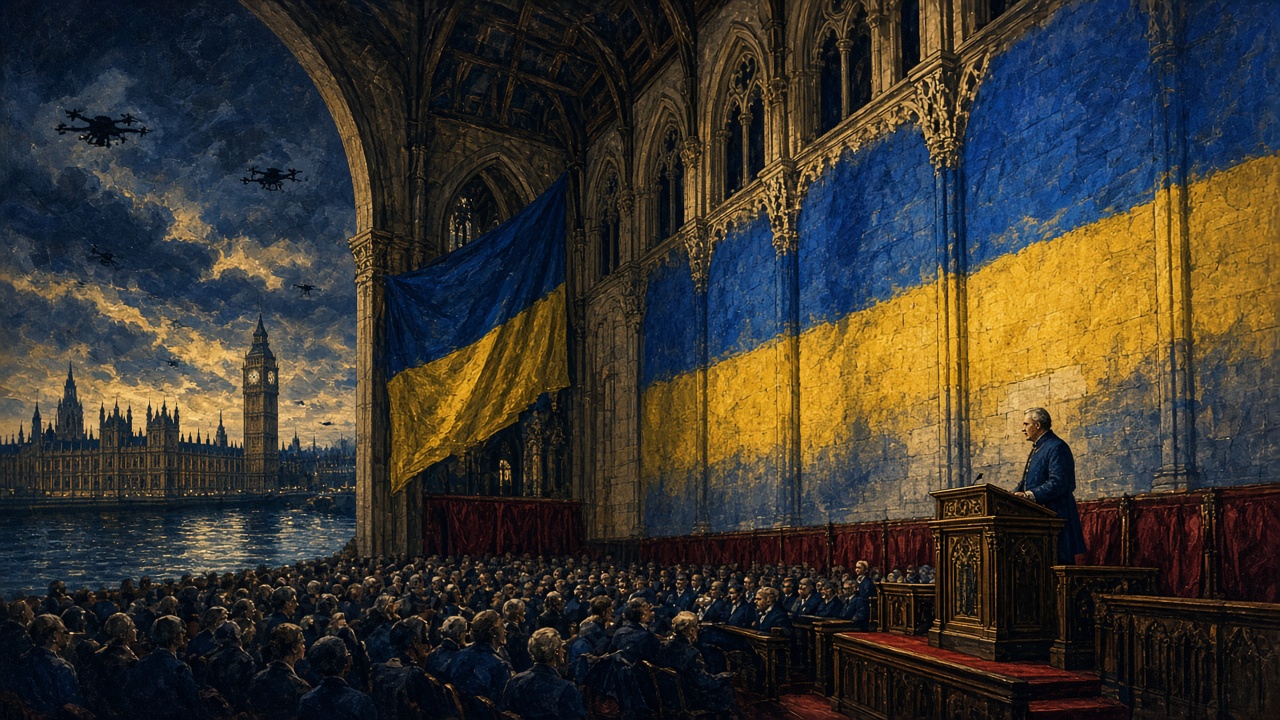
President Volodymyr Zelensky of Ukraine addressed around 60 parliamentarians at Westminster on Tuesday, describing the Iranian and Russian regimes as "brothers in hatred" and warning that the drone warfare pioneered on his country's battlefields now threatens every capital in Europe.
The address came at a moment of acute tension, weeks after the United States and Israel struck Iran on 28 February, and after the UK government refused in February to allow British bases to be used in support of potential American strikes on Iran. It was Mr Zelensky's first address to British parliamentarians since the strikes on Iran reshaped the diplomatic landscape of the war, and he returned to the UK for further talks on Wednesday.
The phrase was the centrepiece of the address. By linking Tehran and Moscow, Mr Zelensky sought to persuade his audience that the war in Ukraine and the conflict in the Middle East are not separate emergencies competing for Western attention but fronts in a single struggle, sustained by the same weapons, the same tactics and increasingly the same technology.
The drone warning
Central to that argument is the drone. Iranian designed attack drones have been used extensively against Ukrainian cities, and their wreckage has become evidence, in Ukrainian hands, of the practical alliance between the two regimes. Mr Zelensky's warning was directed at European governments: the same cheap, long range weapons that strike Kharkiv and Kyiv can, in time, strike anywhere on the continent, and air defence is no longer a Ukrainian requirement but a European one.
Ukraine has answered the threat by becoming the most innovative drone power in Europe, building interceptors and electronic countermeasures at a pace its allies have struggled to match, and it has offered that expertise to partners willing to invest in it.
The Westminster Address
- Volodymyr Zelensky addressed around 60 parliamentarians at Westminster on 17 March 2026.
- He described the Iranian and Russian regimes as "brothers in hatred".
- The speech came weeks after the US and Israel struck Iran on 28 February.
- The UK government refused in February to allow British bases to support potential US strikes on Iran.
- Sir Keir Starmer said in January that MPs would vote on any deployment of British troops to Ukraine.
- Mr Zelensky returned to the UK on 18 March for further talks.
For the British government, the visit demanded careful choreography. London has been among Kyiv's most committed backers, yet it declined to facilitate American strikes on Iran, judging that a wider Middle East war serves neither British interests nor Ukraine's. Sir Keir Starmer's pledge in January that MPs would vote on any deployment of British troops to Ukraine hangs over every discussion of deeper involvement, a reminder that parliamentary consent is now part of the price of British commitments.
Mr Zelensky's audience understood the subtext. A request framed as solidarity between democracies is also a request for weapons, money and patience from a parliament that has already promised much of all three. The applause in Westminster was genuine, but so is the arithmetic facing the government: every pound and every missile sent east is one not held in reserve for a Middle East conflict Britain has tried to keep at arm's length.
What Europe heard
Beyond Westminster, the speech was aimed at a continent still arguing about the scale and speed of its own rearmament. Mr Zelensky's case, that drone warfare has abolished the distance between front line and capital, is also the case being made by defence chiefs from Warsaw to Stockholm. Several European governments have already begun urgent reviews of their air defences, and the question of who pays for a continental shield has moved from think tank papers to finance ministry desks. The logic is visible in procurement decisions: interceptor drones, once a niche purchase, now feature in the defence plans of governments that two years ago had none.
Whether the warning accelerates European air defence cooperation, or is absorbed as one more alarm among many, will become clear in the budgets of the coming year. Mr Zelensky's return to the UK on 18 March, a second day of talks, underlined how central Britain remains to Ukraine's diplomatic map of Europe. For now, the phrase of the week in Westminster is his: brothers in hatred, and the weapons they share.