
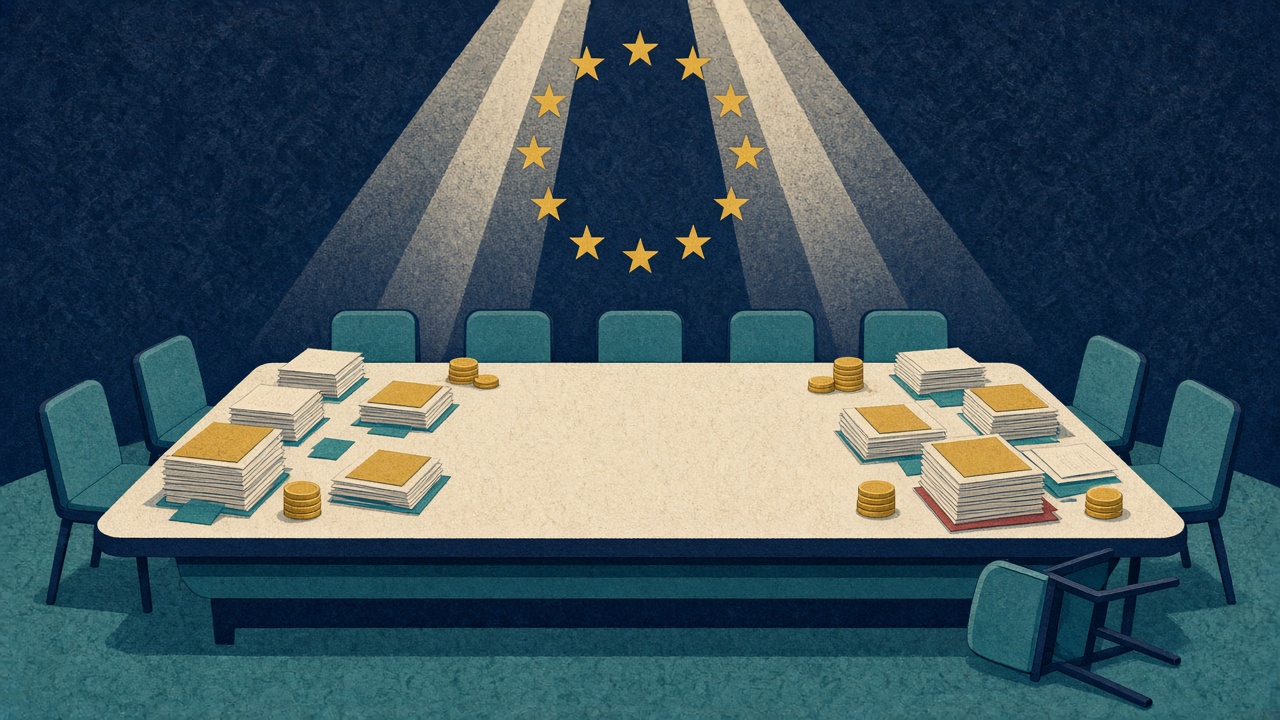
Ireland's presidency of the Council of the EU learned on Saturday how quickly goodwill evaporates in a budget fight. Dublin's proposal to trim around 159 billion euros, roughly eight per cent, from the European Commission's near two trillion euro plan for 2028 to 2034 was presented in the morning and dismissed by Berlin before the day was out.
"The size of the new proposal is no basis for an agreement," Chancellor Friedrich Merz said in a statement, adding that the EU budget "must remain affordable for the countries that shoulder the greatest share of its financing". Germany contributes roughly a quarter of the common pot, and its frugal allies, including the Netherlands, Sweden and Austria, want cuts of several hundred billion euros, not tens of billions.
Berlin objects as much to the distribution as to the total. Mr Merz's government wants spending redirected towards competitiveness, research, defence and foreign policy, and sees the Irish arithmetic as preserving too much of the old settlement.
The Budget Battle at a Glance
- Ireland, holder of the Council presidency, proposed cutting about 159 billion euros from the 2028 to 2034 budget.
- The plan would reduce the Commission's near 1.985 trillion euro proposal to about 1.826 trillion.
- Chancellor Merz rejected it within hours, saying it was no basis for an agreement.
- Frugal net contributors want cuts of several hundred billion euros instead.
- EU leaders discuss the budget at a Brussels summit on Thursday and Friday, 15 and 16 October.
- Governments hope to settle the budget by year's end, before 2027 elections in France, Italy and Poland.
Ukraine hangs over everything
The summit's defining question, though, is money for Kyiv. Ukraine's finance minister Sergii Marchenko has told partners that the 90 billion euro support loan agreed last December is not sufficient, and that 2027 leaves a funding gap of about 78 billion dollars, the most complicated budget, he says, since the full-scale invasion began. His message to a think-tank audience this week was blunt: "We're very happy with the 90 billion, but it's not sufficient."
Disbursement is its own problem. Of the 45 billion euros earmarked for this year, only 14.9 billion has reached Kyiv, held up in part by reforms Brussels demands of the Ukrainian parliament. Draft summit conclusions call on all sides to intensify efforts to unblock the money, while Kyiv presses leaders to revisit the roughly 210 billion euros of immobilised Russian central bank assets. Belgium, custodian of most of those assets, remains resistant, and France and Italy are reluctant to break new legal ground after December's bruising failure.
The Burnham-Merz axis
The budget row broke two days after Mr Merz hosted Andy Burnham in Berlin for the new Anglo-German security pact, a partnership both leaders framed as practical: shared intelligence on sabotage, coordinated responses to state sponsored hacking and closer work on shipping lanes. Britain sits outside the EU budget negotiation, but its security relationship with Germany now matters to both capitals precisely because the Union's internal arithmetic is so contested.
Mr Merz was in Kyiv last weekend, announcing 1.3 billion euros of military and energy support as Russian drones struck the capital during his visit, including a package for joint production of anti-jet drones. With Washington proposing fresh talks with both Ukraine and Russia by the end of the month, Europe's leaders gather next week knowing the decisions they dodge now will return at a higher price.