
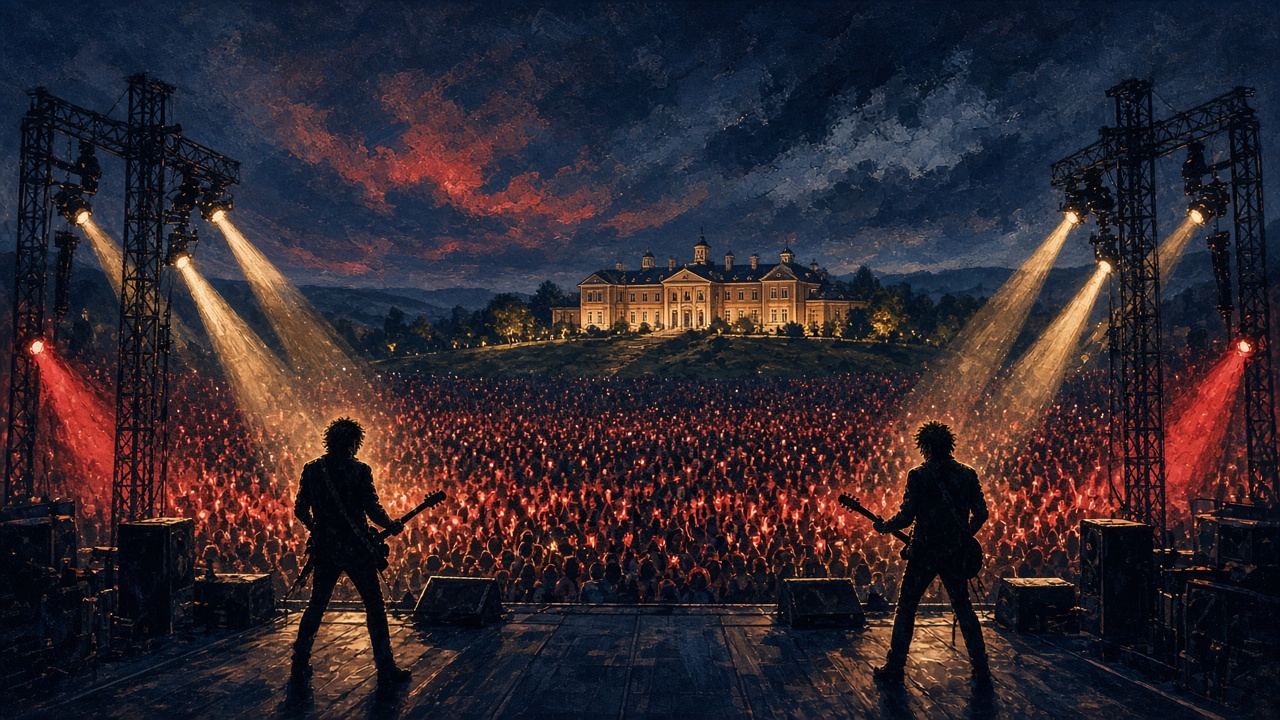
The reunion, it turns out, was only the beginning. Oasis announced their Live 27 tour on Monday, a 42 date world itinerary crowned by a return to Knebworth thirty years after the concerts that defined an era, and by the end of the weekend every ticket had gone.
The tour opens in Glasgow on 21 May 2027 with five nights at Celtic Park, before an eleven date residency at Manchester's Etihad Stadium, a short walk from where the Gallagher brothers grew up. Two nights at Slane Castle in Ireland follow, then the centrepiece: four nights at Knebworth, extended from the original plan after demand overwhelmed the first announcement. Munich, Barcelona, Amsterdam, Paris, Rome, Boston and Las Vegas complete a schedule that confirms the reunion era as a global undertaking rather than a domestic lap of honour.
All 42 shows sold out after staggered weekend ticket sales, a release pattern designed to manage demand that nonetheless crashed waiting rooms and frayed tempers. Fans reported queues running into the millions for the Knebworth dates, with the four nights gone within hours of the final release window opening. The band issued repeated warnings to fans not to buy ticket codes from touts, cautioning that codes advertised online were likely to be worthless and that official resale channels were the only safe route.
The warnings were necessary. Within minutes of the first sale, codes were being offered on secondary platforms at many times their face value, and consumer groups repeated the band's advice that such purchases carry no guarantee of entry. The scramble echoed the chaos of the 2025 reunion sale, which prompted parliamentary questions and promises of tighter rules on resale.
The economics of the reunion era
The numbers behind Live 27 are of a kind usually associated with national infrastructure. Eleven nights at the Etihad alone represent more than half a million tickets; the Knebworth run will host crowds comparable to the quarter of a million who attended across the two original shows in 1996. Hotels in Glasgow, Manchester and Stevenage reported sell-out weekends within hours of the announcement. Industry estimates suggest the reunion era, spanning the 2025 tour, the new documentary and now Live 27, has become one of the most lucrative ventures in the history of British music.
There will be no Glastonbury. Emily Eavis ruled out a 2027 appearance, ending months of speculation that the band would crown the festival's return. The decision fits the pattern of the reunion: Oasis have built their own stages rather than borrowing anyone else's, and a band that can sell eleven nights in its home city has no need of Worthy Farm.
Live 27 at a Glance
- Live 27 was announced on 14 September 2026, thirty years after the original Knebworth concerts of 1996.
- The tour opens on 21 May 2027 with five nights at Celtic Park in Glasgow.
- An eleven date residency at Manchester's Etihad Stadium and two nights at Slane Castle follow.
- Four nights at Knebworth, extended after demand, plus shows in Munich, Barcelona, Amsterdam, Paris, Rome, Boston and Las Vegas.
- All 42 shows sold out after staggered weekend ticket sales.
- The band warned fans against buying ticket codes from touts; Emily Eavis ruled out Glastonbury 2027.
The meaning of Knebworth
Symbolically, Knebworth is the point. The 1996 concerts, performed to 250,000 people over two nights, were Britpop's coronation and, in retrospect, its peak. More than two and a half million people applied for tickets then, a record that stood for years. To return three decades later is to invite comparison with a version of the band, and of the country, that exists now mostly on film.
Not everyone is thrilled. Residents near Knebworth have heard it all before, and Hertfordshire's roads will brace for four weekends of pilgrimage. But the local economy remembers 1996 fondly, and the pubs of Stevenage are already counting.
The lesson of the reunion era is that demand for Oasis has never really been the problem. Supply, as ever with the Gallaghers, is the thing they control absolutely, and on Monday they reminded the music industry who still sets the pace. Thirty years on, the biggest band of the nineties is simply the biggest band.